On November 13, 2026, Canada's Minister of Finance, François-Philippe Champagne, designated the Financial Data Exchange (FDX), acting through its new FDX Canada Council, as the technical standards body for consumer-driven banking. The Ombudsman for Banking Services and Investments (OBSI) became the external complaints body. Both orders were published in the Canada Gazette on November 21, 2026.
Key facts
- Technical standard: Financial Data Exchange Inc., acting through its FDX Canada Council, sets the standard that banks and accredited providers use to share data (Canada Gazette, Part I, 21 November 2026)
- Canadian control: the Council decides independently of the FDX board, only Canadian residents and businesses can vote, and Canada can use and amend the standard "in perpetuity" (Finance Canada, 20 November 2026)
- Complaints: OBSI will investigate unresolved consumer-driven banking complaints, as it already does for banks
- Oversight: the Bank of Canada supervises banks, accredited third parties, FDX and OBSI, and keeps a public registry
- Still to come: the final regulations and go-live dates. The first phase is read-only; payment initiation comes later
Disclosure: FDX is an Open Banking Tracker partner.
What did Canada announce?
Two designations under the Consumer-Driven Banking Act, both signed on November 13, 2026:
| Role | Organization | What it does |
|---|---|---|
| Technical standards body | Financial Data Exchange Inc., acting through its FDX Canada Council | Sets the common technical specifications, data definitions and security protocols for data sharing |
| External complaints body | Ombudsman for Banking Services and Investments (OBSI) | Investigates unresolved complaints from consumers and recommends a resolution |
Finance Canada called the designations "an important milestone toward implementing Canada's Consumer-Driven Banking Framework." They give banks and fintechs a fixed target to build against while the final regulations are written.
Why FDX?
FDX is the industry-led standard that most consumer-permissioned data sharing in North America already runs on. FDX says more than 114 million customer connections run on APIs aligned with its standard, and it counts more than 200 members: banks, fintechs, data aggregators and payment networks (FDX).
FDX is not new to Canada. It has worked there since 2020, starting with 31 founding Canadian financial institutions, fintechs, aggregators and industry bodies, and it now has more than 70 member organizations that operate in Canada (FDX Canada). The designation builds on that work instead of starting a new specification from scratch.
The order lists what the Minister weighed: FDX's willingness and ability to serve, interoperability with foreign frameworks, a guarantee that the standard "is not withdrawn, including in the event of the body's dissolution", and support for Canadian-led decision-making.
For developers the case is simple: one standard on both sides of the border. A bank or fintech that builds to FDX for the US, where FDX is the leading standard for Section 1033, can reuse most of that work in Canada. More on the standard itself is on our FDX guide.
What is the FDX Canada Council?
The FDX Canada Council is the body inside FDX that develops and maintains the standard for Canada. Finance Canada calls it a "made-in-Canada approach that safeguards Canadian sovereignty over the technical standard":
- it can make decisions independently from the broader FDX board
- voting membership is limited to Canadian residents and businesses
- Canada can use and amend the standard on a sovereign basis, in perpetuity
FDX says Canadian updates will go into the next version of its standard. Jason Chomik is FDX's Director, Canada.
Where does consumer-driven banking stand now?
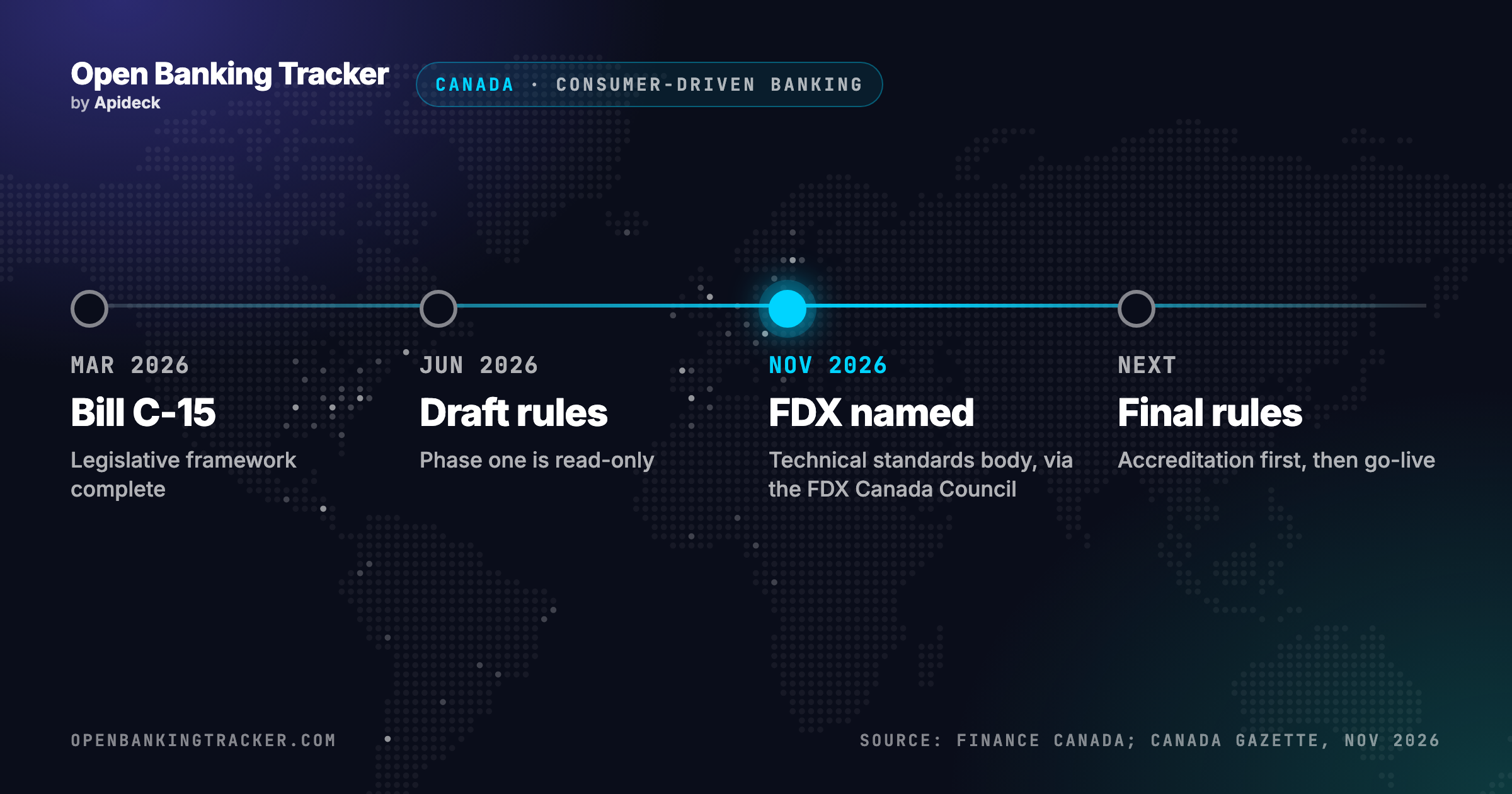
| Date | Step |
|---|---|
| June 2024 | Consumer-Driven Banking Act enacted in Bill C-69 |
| November 2025 | Budget 2025 names the Bank of Canada to oversee the framework |
| 26 March 2026 | Bill C-15 receives Royal Assent and completes the legislative framework |
| 27 June 2026 | Proposed Consumer-Driven Banking Regulations pre-published for a 60-day comment period |
| 13 November 2026 | FDX and OBSI designated |
| Next | Final regulations, then accreditation, then go-live by product |
The proposed regulations (Canada Gazette, Part I, 27 June 2026) set out the rest of the framework:
- Scope: deposit accounts, payment products, investment accounts (registered and non-registered) and lending accounts, from credit cards to mortgages, phased in by product
- Read-only first: "Framework functionality will be limited to 'read only' access under phase one." Write access, including payment initiation, is left for a second phase
- Who must take part: large banks above a retail-volume threshold. Credit unions, other financial institutions and registered payment service providers can opt in
- Accreditation: third parties need a place of business in Canada, insurance and a security baseline, and pay a proposed $2,500 application fee
- Assessment fees: proposed base fees from $10,000 to $150,000 a year for participating entities by asset size, and $10,000 for accredited third parties
- Timing: a staggered start, "beginning with accreditation, followed by requirements related to common rules and assessment fees within one year of final publication" (Finance Canada, June 2026)
No go-live date has been set. When we wrote about what is coming in 2026 and 2027 in March, the Bank of Canada had not committed to a timeline either. What has changed is that every piece of the framework now has a named owner.
What should banks and fintechs do now?
- Banks: build to the FDX standard and follow the FDX Canada Council's work. Large banks will be mandated, and the proposed regulations set availability and data-history requirements that call for production-grade APIs, not pilots
- Fintechs and aggregators: prepare for accreditation, which comes into force first. If you already connect to US banks over FDX, map that integration to the Canadian scope
- Everyone using screen scraping: about nine million Canadians share data that way today, according to Finance Canada. The framework is built to replace it with API-based sharing
The Open Banking Canada page lists Canadian banks and their API status, and the regulation tracker keeps the timeline current.
Frequently asked questions
Who is the technical standards body for open banking in Canada?
The Financial Data Exchange (FDX), acting through its FDX Canada Council. Canada's Minister of Finance designated it on November 13, 2026 under the Consumer-Driven Banking Act, and the order was published in the Canada Gazette on November 21, 2026.
What is the FDX Canada Council?
The body inside FDX that develops and maintains the technical standard for Canada. It can decide independently of the FDX board, only Canadian residents and businesses can vote, and Canada can use and amend the standard in perpetuity.
Who handles open banking complaints in Canada?
The Ombudsman for Banking Services and Investments (OBSI), designated as the external complaints body on November 13, 2026. It investigates complaints that a bank or accredited provider has not resolved and recommends a resolution.
When does open banking launch in Canada?
No date has been set. The proposed regulations come into force in stages, starting with accreditation, and the order in which products go live will be set in the final regulations. The first phase is read-only; payment initiation follows later.
Does Canada's open banking include payment initiation?
Not in the first phase. The proposed regulations limit phase one to read-only data sharing. Write access, which covers payment initiation, is planned for a second phase.
Is the Canadian FDX standard the same as the US one?
It is the same FDX standard, with Canadian decisions made by the FDX Canada Council and folded into new versions. A bank or fintech that already uses FDX in the US can reuse most of that work in Canada.