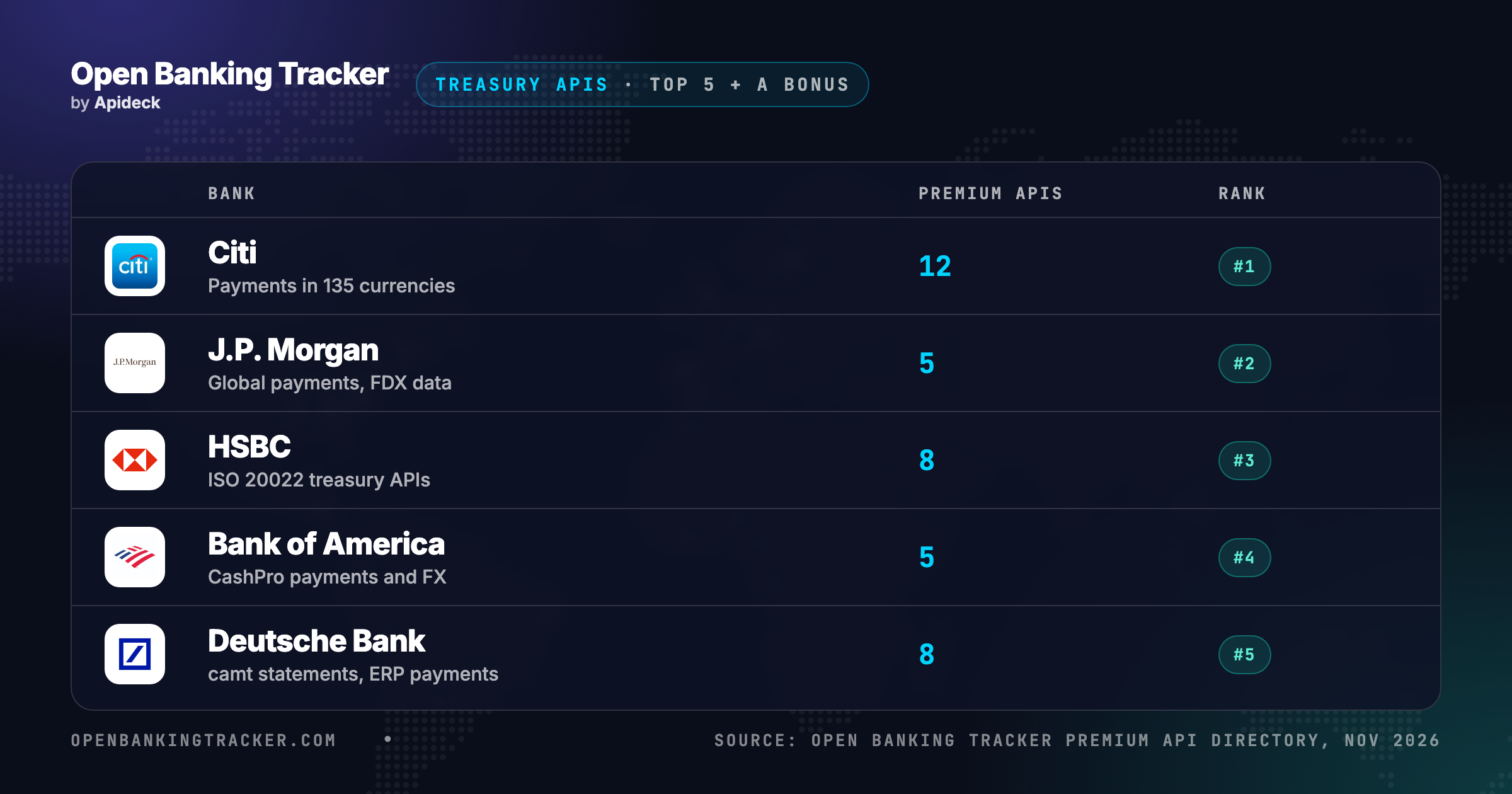
The best treasury APIs come from the large corporate banks. Citi, J.P. Morgan, HSBC, Bank of America and Deutsche Bank sell the broadest sets: real-time balances and statements, payment initiation in many currencies, virtual accounts, account validation and FX, built to be called from a company's ERP or treasury management system (TMS). The Open Banking Tracker lists 225 premium API products from 38 banks; these five cover the most treasury ground across the most markets.
Key facts
- How we picked: banks in the tracker's premium banking API directory, ranked on the treasury jobs their live APIs cover (balances and statements, payments, virtual accounts, validation, FX) and the markets they reach
- Most products: Citi, Wells Fargo and U.S. Bank each list 12 live premium APIs
- Statements in ISO 20022: Citi, HSBC and Deutsche Bank return statements and balances in camt formats, which makes them easier to reconcile against the ERP
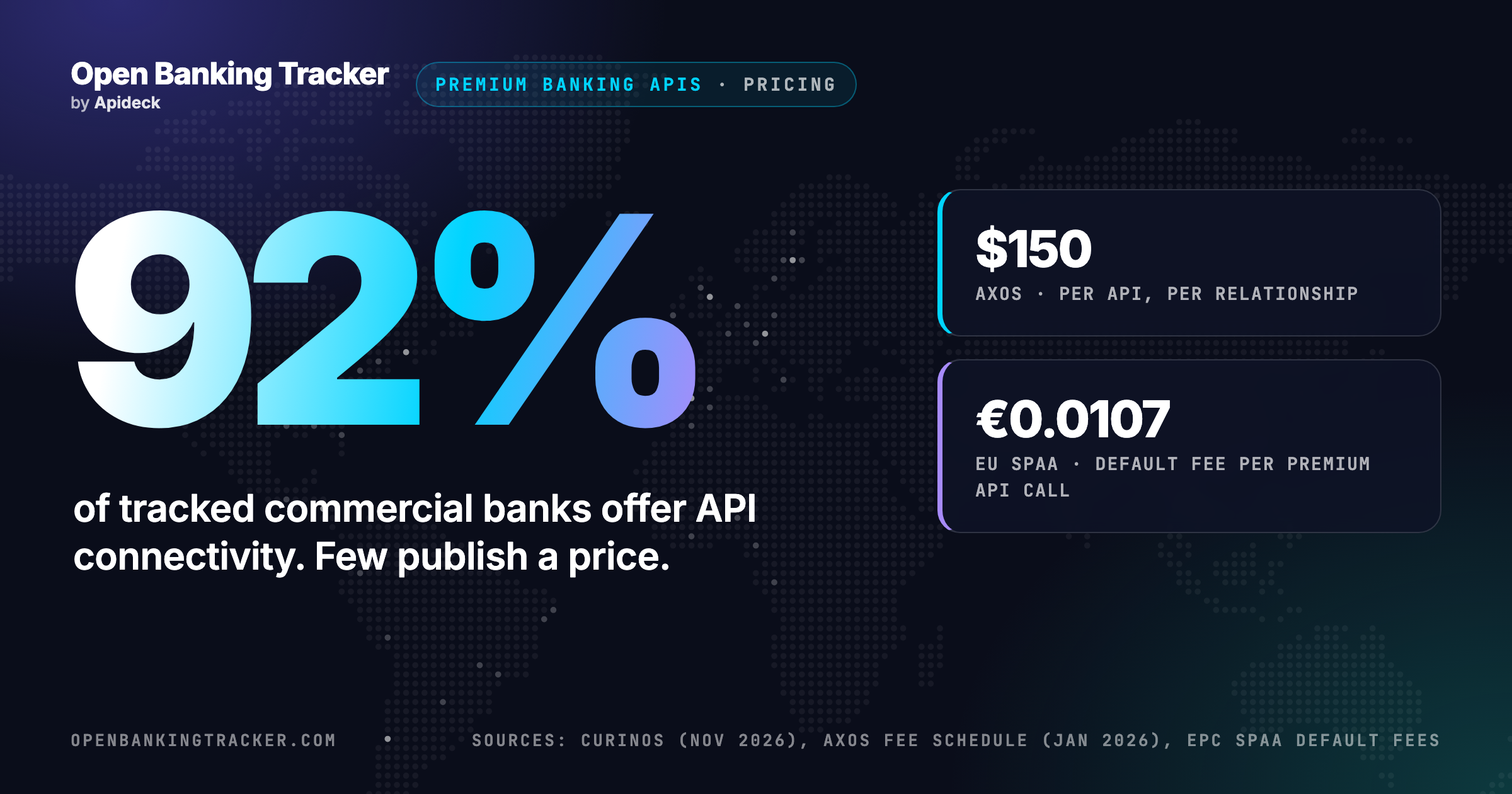
- Access: all five sell their treasury APIs to their own corporate clients under contract; none publishes a per-call price (see what banks charge for premium APIs)
- Bonus: the US Treasury's Fiscal Data API is the free, public "treasury API" for government data such as the national debt and Treasury exchange rates
What is a treasury API?
A treasury API is an interface a company's treasury software uses to see and move cash at its bank: account balances and statements, payment initiation and status, virtual accounts, account validation and FX. Banks sell them to their business clients as corporate or premium APIs, on top of the free access that open banking rules require. The difference is explained in open banking vs premium banking APIs.
The top 5 treasury APIs
| Rank | Bank | Live premium APIs | Treasury coverage | Strongest for |
|---|---|---|---|---|
| 1 | Citi | 12 | Balances, statements (MT940/942, camt), notifications, virtual accounts, instant, bulk and cross-border payments, validation, virtual cards | Multinationals that pay and collect in many countries |
| 2 | J.P. Morgan | 5 | FDX account data, global payments (ACH, wire, RTP, push to card), embedded payments with virtual accounts, account validation | US treasury and platforms embedding payments |
| 3 | HSBC | 8 | ISO 20022 account information, single, bulk and real-time payments, 140+ currency disbursements, virtual accounts, SWIFT gpi tracking, trade finance | Cross-border payments and trade |
| 4 | Bank of America | 5 | CashPro payments, request for payment, account validation, reporting, FX trading | US companies already on CashPro |
| 5 | Deutsche Bank | 8 | Credit transfers from the ERP or TMS, request to pay, real-time balances (camt.052), statements (camt.053), pre-validation, FX4Cash | European treasury and euro payments |
1. Citi
Citi has the widest treasury API catalogue of any bank in the tracker. Its CitiConnect APIs return intraday and end-of-day balances, optionally including balances held at other banks, and statements in MT940/942 or camt formats for reconciliation. On the payments side it covers domestic instant payments in 30+ countries, bulk payments in one call, and WorldLink cross-border transfers in up to 135 currencies with FX. Virtual accounts, pre-payment validation, proof of payment and commercial virtual cards round it out. Citi's premium APIs
2. J.P. Morgan
J.P. Morgan's Global Payments API sends ACH, wire, RTP, push-to-card and other payment types across markets through one integration, and Account Validation Services checks account ownership before paying. Business Direct Connect gives commercial clients FDX-based access to balances and transactions. Its Embedded Payments API lets platforms open virtual transaction accounts for their own clients and pay out from them. J.P. Morgan's premium APIs
3. HSBC
HSBC labels its core APIs as treasury products: Treasury Account Information returns real-time balances and transactions in ISO 20022 format, and Treasury Payment Initiation handles single, bulk and real-time payments across its network. Global Disbursements pays out in over 140 currencies from one account, and SWIFT gpi tracking follows cross-border payments by UETR. It is also one of the few banks with trade and supply chain finance APIs that can be called from an ERP. HSBC's premium APIs
4. Bank of America
Bank of America runs its treasury APIs through CashPro, its cash management platform: payment initiation and tracking for ACH, wire and RTP, request for payment, US account validation, near-real-time balances and end-of-day reporting, and FX execution at live or guaranteed rates. A natural fit for companies already using CashPro online. Bank of America's premium APIs
5. Deutsche Bank
Deutsche Bank's corporate APIs are built around ISO 20022: real-time balances in camt.052 and intraday and end-of-day statements in camt.053, pushed or pulled. CB Connect sends credit transfers straight from a company's ERP or TMS, db Smart Access connects a business's accounts to its ERP, and FX4Cash streams rates for 125+ currencies. Request to Pay and SEPA Instant cover euro collections and payments. Deutsche Bank's premium APIs
Also worth a look
Wells Fargo and U.S. Bank each list 12 live premium APIs, mostly US payments and reporting. In Europe, ABN AMRO (11), Rabobank and Danske Bank cover balances, payments, verification of payee and FX. The full list, filterable by region and category, is in the premium banking API directory.
Bonus: the US Treasury Fiscal Data API
Many searches for "treasury API" are not about corporate treasury at all. They are about the US Treasury's Fiscal Data API, which publishes federal government financial data: the national debt (Debt to the Penny), the Daily Treasury Statement, average interest rates on Treasury securities, and the Treasury Reporting Rates of Exchange used for foreign currency conversion.
It is free, needs no key or registration, and answers plain GET requests with JSON:
https://api.fiscaldata.treasury.gov/services/api/fiscal_service/v2/accounting/od/debt_to_penny?sort=-record_date&page[size]=1
That call returns the latest total public debt outstanding. It does not touch a company's bank accounts; for that you need the bank APIs above.
The other half: the ERP
A bank API tells treasury where the cash is. The ERP knows what it is committed to: open payables and receivables, the ledger, and the entries treasury has to book for payments, fees, interest and FX. Treasury software sold to many companies connects to both, the bank through its corporate API and the ERP through its API. Apideck's guide to treasury APIs explains how the two fit together, and its Accounting API covers the ERP side across NetSuite, Business Central, Xero, QuickBooks and others.
Frequently asked questions
What are the best treasury APIs?
For corporate treasury, the broadest treasury APIs come from Citi, J.P. Morgan, HSBC, Bank of America and Deutsche Bank. They cover balances and statements, payments in many currencies, virtual accounts, account validation and FX. Which is best depends on where your company banks: a treasury API only works for accounts held at that bank.
Are treasury APIs free?
Banks' corporate treasury APIs are sold to their own clients, usually priced into the cash management contract; few banks publish a price. The US Treasury's Fiscal Data API, for government data, is free and needs no key.
What is the difference between a treasury API and an open banking API?
Open banking APIs give licensed third parties regulated access to account data and payments, mostly for consumer apps. Treasury APIs are commercial products a bank sells its corporate clients, with features open banking does not cover, such as bulk and cross-border payments, intraday reporting, virtual accounts and FX.
Can a treasury management system connect to these APIs?
Yes. Deutsche Bank's CB Connect, for example, is built for payments initiated from an ERP or TMS, and most treasury management systems connect to banks through these APIs, host-to-host files or SWIFT. They also need the ERP for payables, receivables and the ledger.
Disclosure: the Open Banking Tracker is published by Apideck.