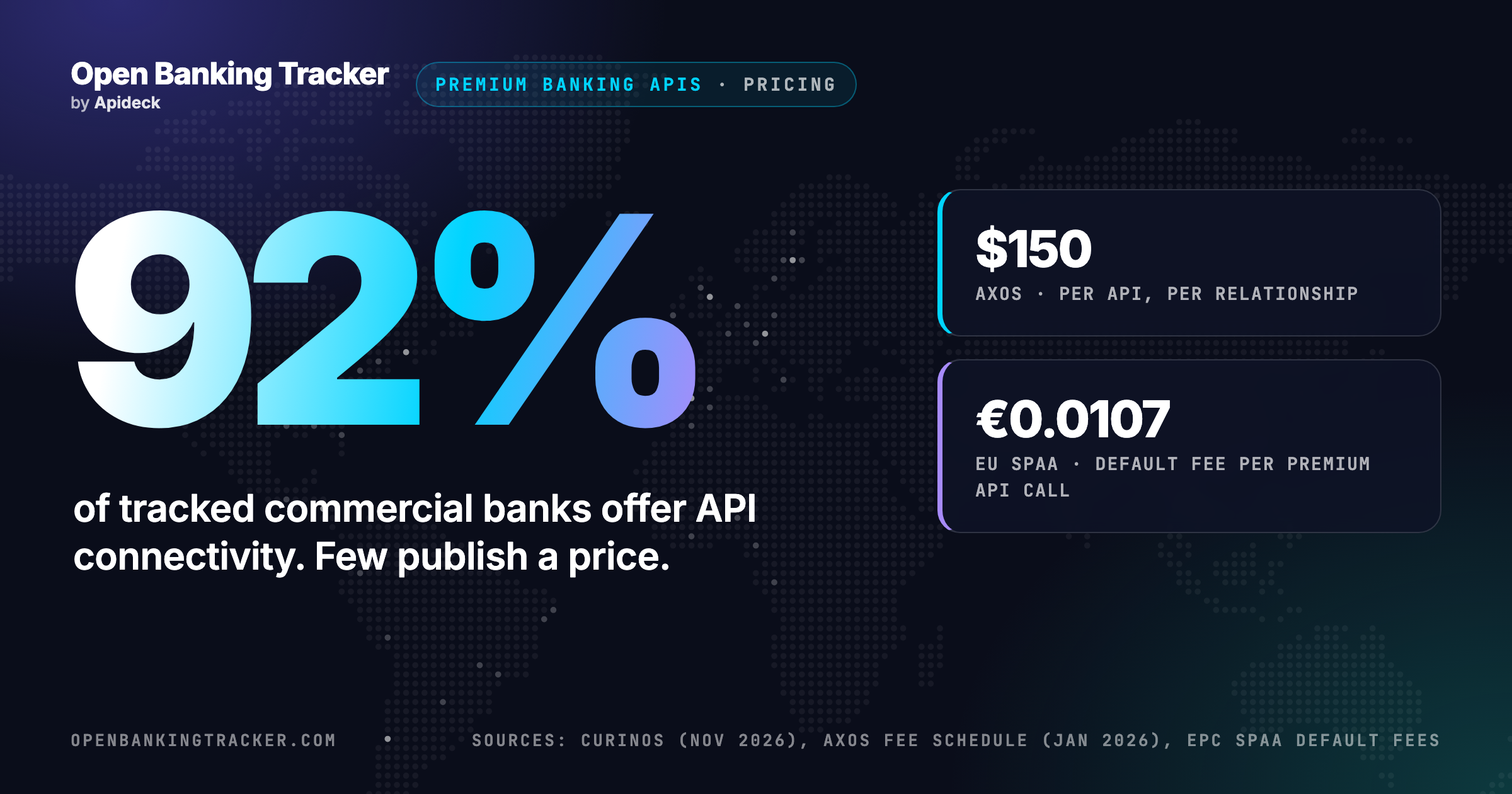
Banks now treat corporate APIs as standard: Curinos found API connectivity at 92% of the 12 commercial banks it has tracked since 2023. What they charge for those premium banking APIs is another matter. Few banks publish a price. Most quote one per client, and Europe and the UK are the only places where a scheme sets a public default fee.
Key facts
- Coverage: 92% of the 12 commercial banks Curinos tracked in both 2023 and 2026 offer API connectivity; ERP integration rose from 75% to 92% (Curinos, 5 November 2026)
- A published US price: Axos Bank lists $150 per relationship for each treasury API, from balance inquiry to wire origination (fee schedule, January 2026)
- Priced on request: BMO's sandbox and pre-production are free, and production is "contact us to discuss pricing" (BMO developer FAQ); ING lists its file and EBICS channel at €280 a month, while its payment and reporting APIs are "subject to agreement" (ING tariff brochure)
- Scheme defaults: the EU's SPAA scheme sets €0.0107 per premium API call plus a fee per asset; the UK's commercial VRP scheme charges a per-transaction access fee set by an independent committee
- Consumer data is a separate fight: J.P. Morgan says aggregators pay it about a quarter of a cent per data pull (J.P. Morgan, August 2026)
What counts as a premium banking API?
A premium banking API is a commercial API a bank offers to business clients under contract, beyond the access that regulation requires for free. In Europe that baseline is PSD2; in the UK it is the CMA's Open Banking order; in the US it is Section 1033, which is still being rewritten. Premium APIs cover what treasury teams actually run: real-time balances, ACH and wire initiation, payment status, virtual accounts and account validation.
The tracker's premium banking API directory lists them bank by bank, and open banking vs premium banking APIs explains the difference.
Which banks publish a price?
Very few. In our review of bank fee schedules, developer portals and tariff brochures:
| Bank or scheme | What is public | Price |
|---|---|---|
| Axos Bank (US) | A full treasury fee schedule | $150 per relationship for each API: balance inquiry, prior-day reporting, ACH origination, wire origination and more |
| BMO (Canada, US) | Developer FAQ | Sandbox and pre-production free; production "contact us to discuss pricing" |
| ING (Germany) | Wholesale tariff brochure | File, EBICS and Swift channel €280 a month plus €5,000 set-up; payment and reporting APIs "subject to agreement" |
| J.P. Morgan, Bank of America, Citi, U.S. Bank, PNC | Developer portals and product pages | No public price; access runs through a relationship or treasury manager |
| EU SPAA scheme | Default fee schedule | €0.0107 per premium API call, plus about €0.009 to €0.038 per asset or feature |
| UK commercial VRP (UKPI) | Scheme fee model | A per-transaction access fee set by an independent pricing committee |
The pattern is the same on both sides of the Atlantic. Where a bank publishes anything, it publishes a price per relationship or per month, not per call. Everywhere else, the API is priced into the client's cash-management contract.
Why banks don't publish API prices
Corporate API access is not self-serve. The company has to be the bank's client, and the bank switches the API on for that client: through a relationship manager, a testing phase and its own certificates. Price is part of that same negotiation, next to account analysis fees and payment volumes, so a public list price would only anchor the conversation.
There is one exception to the per-client model. J.P. Morgan's Banking Authorization Service lets a platform connect once and lets each corporate link its own J.P. Morgan accounts in seconds, on the platform's certificates. Embat, a treasury software company, said in November 2026 that it cut J.P. Morgan onboarding from months to days this way. Pricing for it is not public either.
How Europe and the UK set default prices
Europe and the UK took a different route: a scheme sets a fallback price, and banks and providers can agree less bilaterally.
- EU, SPAA. The European Payments Council's SEPA Payment Account Access scheme has been live since November 2023. Its default fees charge €0.0107 per premium API call, plus a fee for each premium asset, such as €0.0165 for a dynamic recurring payment or €0.0375 for a refund. As of August 2026 the scheme's register listed five participants, GoCardless, Token, TrueLayer, Yapily and Tink, all on the buying side and no bank yet (PaymentBrief).
- UK, commercial VRP. The UK Payments Initiative's first wave went live in June 2026 for regulated financial services, utilities, government and charities. Payment initiation providers pay banks a per-transaction access fee, set by an independent committee overseen by the FCA and the Payment Systems Regulator (Finextra). Our commercial VRP guide covers the scheme.
How this differs from the aggregator fee fight
The fees above are what businesses and their providers pay for corporate APIs. The louder debate in the US is about consumer data: J.P. Morgan charging aggregators such as Plaid for data pulls, and banks arguing that the next Section 1033 rule should let them charge. That story is in open banking data access fees and the Section 1033 status tracker.
What it means for treasury teams and platforms
- Budget per bank, not per call. Expect a relationship or monthly fee per API, negotiated with your treasury manager, not a metered bill.
- Ask early. Pricing, testing and certificates come as one onboarding project, so raise them when you first ask for API access.
- Platforms pay twice. A software platform connecting many clients to many banks pays the bank side per client and carries the integration cost per bank. That is the market multi-bank connectivity providers sell into: Trovata, for example, lists its base package at $24,000 a year for one bank and 100 accounts (Trovata pricing).
- ERP connectivity is where banks compete next. Curinos's figures put ERP integration at 92% of tracked banks. How banks reach their clients' accounting systems is in bank feeds for ERP and accounting software.
Frequently asked questions
Do banks charge for corporate APIs?
Usually, yes, but rarely in public. Most large banks price API access as part of a client's cash-management contract, negotiated through a relationship manager. Axos Bank is an exception that publishes a price: $150 per relationship for each treasury API in its January 2026 fee schedule.
How much does a premium banking API cost?
Where prices are public, they are per relationship or per month: $150 per API per relationship at Axos Bank, for example. In the EU, the SPAA scheme's default is €0.0107 per premium API call plus an asset fee of about one to four euro cents. Most large banks quote per client.
Are open banking APIs free?
The regulated baseline is free in Europe and the UK: banks must give licensed providers basic account access and payment initiation under PSD2 and the CMA order without charge. Premium APIs beyond that baseline, such as commercial VRP or SPAA premium services, carry fees.
What is the SPAA scheme?
SPAA (SEPA Payment Account Access) is a European Payments Council scheme for premium open banking APIs. Banks can charge providers for premium data and payment services, under a default fee schedule that applies unless the two agree a lower price. It has been live since November 2023.
Which banks offer premium APIs?
Most large commercial banks do, including J.P. Morgan, Citi, Bank of America, U.S. Bank, PNC, HSBC, Deutsche Bank, ING and Danske Bank. The Open Banking Tracker's premium banking API directory lists each bank's products, from ACH and wire initiation to virtual accounts and real-time balances.