In short: FIDA, the EU's proposed Financial Data Access Regulation, is being withdrawn. On 4 November 2026 the European Commission put it on the withdrawal list (Annex III) of its 2027 work programme, saying the file has stalled, with no trilogues since June 2025 and little chance of Council support. The Commission intends to withdraw it within six months, and no replacement has been announced. Regulated open banking stays limited to payment accounts under PSD2 and the incoming Payment Services Regulation (PSR). Access to other financial data, such as savings or pension data, stays a matter of commercial deals. FIDA never covered accounting software, so SME financial data in ledgers is still reached the way it is today: through accounting APIs, with the business's permission.
What is FIDA?
FIDA is the European Commission's proposal for a Regulation on a framework for Financial Data Access, published on 28 June 2023 together with the PSD3 and PSR payment proposals. It was the EU's open finance law. PSD2 opened payment account data to licensed third parties in 2018, and FIDA would have extended that idea to most other financial products.
Under the proposal, a financial institution holding customer data (the "data holder") would have had to share it with an authorised third party (the "data user") whenever the customer asked. Data users would be either licensed financial institutions or a new type of licensed firm, the financial information service provider (FISP). Data holders and users would have joined financial data sharing schemes that agree the technical standards and the fee a data holder can charge. Customers would manage every permission they gave through a permissions dashboard.
What is the current status of FIDA?
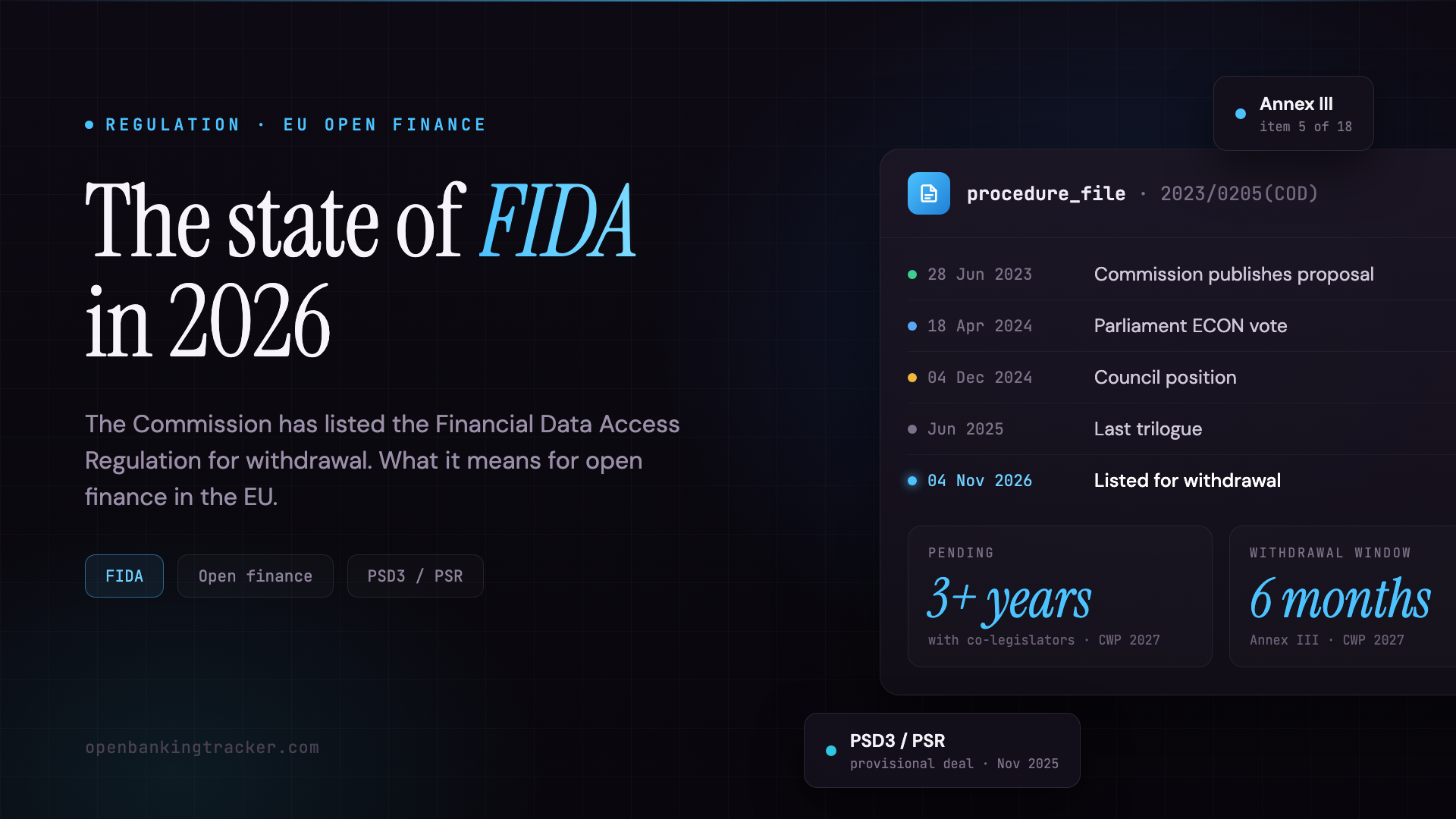
FIDA is on its way out. It is item 5 of the 18 proposals in Annex III ("Withdrawals") of the Commission work programme 2027, adopted on 4 November 2026. The annex says the Commission intends to withdraw the listed proposals within six months, which points to a formal withdrawal by around May 2027.
Until then the file is technically alive. The European Parliament's Legislative Observatory still lists procedure 2023/0205(COD) as awaiting Parliament's first-reading position.
| Date | What happened |
|---|---|
| 28 June 2023 | Commission publishes the FIDA proposal alongside PSD3 and the PSR |
| 18 April 2024 | Parliament's ECON committee votes on its report |
| 4 December 2024 | Council agrees its negotiating position |
| February 2025 | A leaked draft of the 2025 work programme marks FIDA for withdrawal; the final version keeps it |
| June 2025 | Last trilogue meeting |
| 4 November 2026 | Commission work programme 2027 lists FIDA for withdrawal |
| By about May 2027 | Formal withdrawal expected |
Why is the Commission withdrawing FIDA?
The Commission's justification in Annex III reads: "The file has been pending with co-legislators more than three years. No trilogues have taken place since June 2025 and the file is unlikely to secure support in the Council within a reasonable timeframe."
Behind that sentence is a long fight. Insurers were among the most vocal critics: on the day the Council agreed its position in December 2024, the German insurers' association GDV said there was an "extensive need for revisions". The co-legislators also disagreed on how far Big Tech platforms designated as gatekeepers under the Digital Markets Act could use FIDA. A contested new data-sharing obligation for the financial sector sat badly with the simplification theme that runs through the Commission's 2027 programme.
Is the withdrawal of FIDA final?
Not yet. Before the Commission formally withdraws a proposal, the European Parliament and the Council can give their views, and the withdrawal is then published in the Official Journal. A reversal is possible and nearly happened before: in February 2025 a leaked draft work programme also marked FIDA for withdrawal, and the published version kept it on the pending list after pushback inside the Commission. This time the withdrawal is in the adopted document, and the Commission itself says the file is unlikely to secure Council support. Plan on FIDA not coming back in its current form.
What would FIDA have covered?
The Commission's proposal applied to data on both individual and business customers, held by regulated financial institutions such as banks and insurers.
| In scope (Commission proposal, Article 2(1)) | Out of scope |
|---|---|
| Mortgage credit agreements, loans and accounts | Payment accounts (already covered by PSD2) |
| Savings, investments and crypto-assets | Life, sickness and health insurance |
| Occupational and personal pension products | Credit scores of individuals |
| Non-life insurance | Data held by non-financial companies, including accounting software |
| Creditworthiness data a firm gives a lender in a loan application |
The Council's December 2024 position narrowed this. It excluded occupational pension data, with an opt-in for member states, and phased the rules in over 48 months. Later Commission proposals to simplify FIDA would have dropped more entities from scope, such as credit rating agencies and large corporates.
When was FIDA supposed to apply?
Never, as things stand. In the Commission's original proposal, data sharing schemes had to be in place 18 months after the regulation entered into force, with the data sharing obligations applying after that. The Council's version phased the data categories in over 48 months. Because the regulation was never agreed, none of these clocks started.
Does the FIDA withdrawal affect open banking, PSD3 or the PSR?
No. Open banking for payment accounts runs on PSD2 today and will move to the Payment Services Regulation, which is a separate file. Parliament and Council negotiators reached a provisional deal on PSD3 and the PSR on 27 November 2025. The Council's position was published on 5 November 2026, and Parliament's final vote is scheduled for 14 December 2026 (an indicative date). The PSR keeps open banking limited to payment accounts but tightens it. It lists obstacles banks may not put in front of licensed third-party providers, and it gives users a dashboard to see and revoke the data permissions they've granted.
FIDA would have added a second, wider layer on top of that. Withdrawing it leaves the payments layer untouched.
What does the FIDA withdrawal mean for fintechs, lenders and software companies?
If your roadmap assumed a regulated right to pull a customer's savings, investment or pension data from EU financial institutions by 2028 or 2029, take it out. That data stays available only where an institution chooses to offer it, usually under a bilateral contract. GDPR's data portability right still applies to personal data, but it gives you no standard API and doesn't cover business customers.
For B2B lenders, spend management tools and other SME fintechs, the practical effect is smaller than the headlines suggest. FIDA would have covered what a business's banks and insurers hold about it. The richest data on a small business, its financial statements and invoices, lives in its accounting software, and accounting platforms were never data holders under FIDA. So the route to that data hasn't changed: the business authorises access through the accounting vendor's OAuth flow, and you read its books through that vendor's API.
The hard part of that route is the number of APIs. European SMEs keep their books in dozens of different ledgers, from DATEV in Germany to Exact Online in the Netherlands, each with its own data model and partner rules. Apideck's unified accounting API connects to 55+ accounting APIs through one integration, which is how lenders pull up-to-date financials for underwriting without waiting for regulation. Our guide to open accounting explains how this market-led model differs from regulated open banking.
Will open finance come back in the EU?
Possibly, though any comeback would be a new proposal and years away. The Commission announced no replacement in the 2027 work programme. A new proposal would restart the legislative process from scratch. FIDA spent more than three years in negotiation without a deal, and the PSR, proposed on the same day, is only now heading to a final vote. The Data Act, in application since 12 September 2025, gives users access to data generated by connected products such as cars and industrial machines. It wasn't designed for financial account data. For the rest of this decade, open finance in the EU will be built through market-led schemes and commercial APIs.
FAQ
What does FIDA stand for?
FIDA (also written FiDA) stands for Financial Data Access. The full name is the proposed Regulation on a framework for Financial Data Access, COM(2023) 360, procedure 2023/0205(COD).
Has FIDA been withdrawn?
It has been listed for withdrawal. The Commission announced it on 4 November 2026 in Annex III of its 2027 work programme and intends to complete the withdrawal within six months.
Is FIDA the same as PSD3?
No. PSD3 and the PSR cover payment services and access to payment accounts (open banking). FIDA covered financial data beyond payment accounts (open finance). All three were proposed on the same day in June 2023, but PSD3 and the PSR reached a deal in November 2025 while FIDA stalled.
Does FIDA apply in the UK?
No. FIDA was EU legislation. The UK left the EU before it was proposed and runs its own open banking regime.
Did FIDA cover accounting software data?
No. Data holders under FIDA were financial institutions. Accounting and ERP platforms were not in scope, so access to ledger data has always depended on each vendor's API and the business's consent.
What is a FISP?
A financial information service provider. FIDA would have created this licence for firms that access financial data without being a bank or other financial institution, similar to the account information service provider (AISP) licence under PSD2. With FIDA withdrawn, the FISP licence won't exist.
Can I still access a customer's savings or investment data in the EU?
Yes, where the institution offers access voluntarily or under a commercial agreement. No law obliges it to provide an API.
What should EU fintechs do now?
Use PSD2, and later the PSR, for payment account data, and negotiate directly for other financial data. For SME financials, connect to the accounting platforms your customers already use. If you want to pull data from dozens of ledgers through one API, book a demo with Apideck.