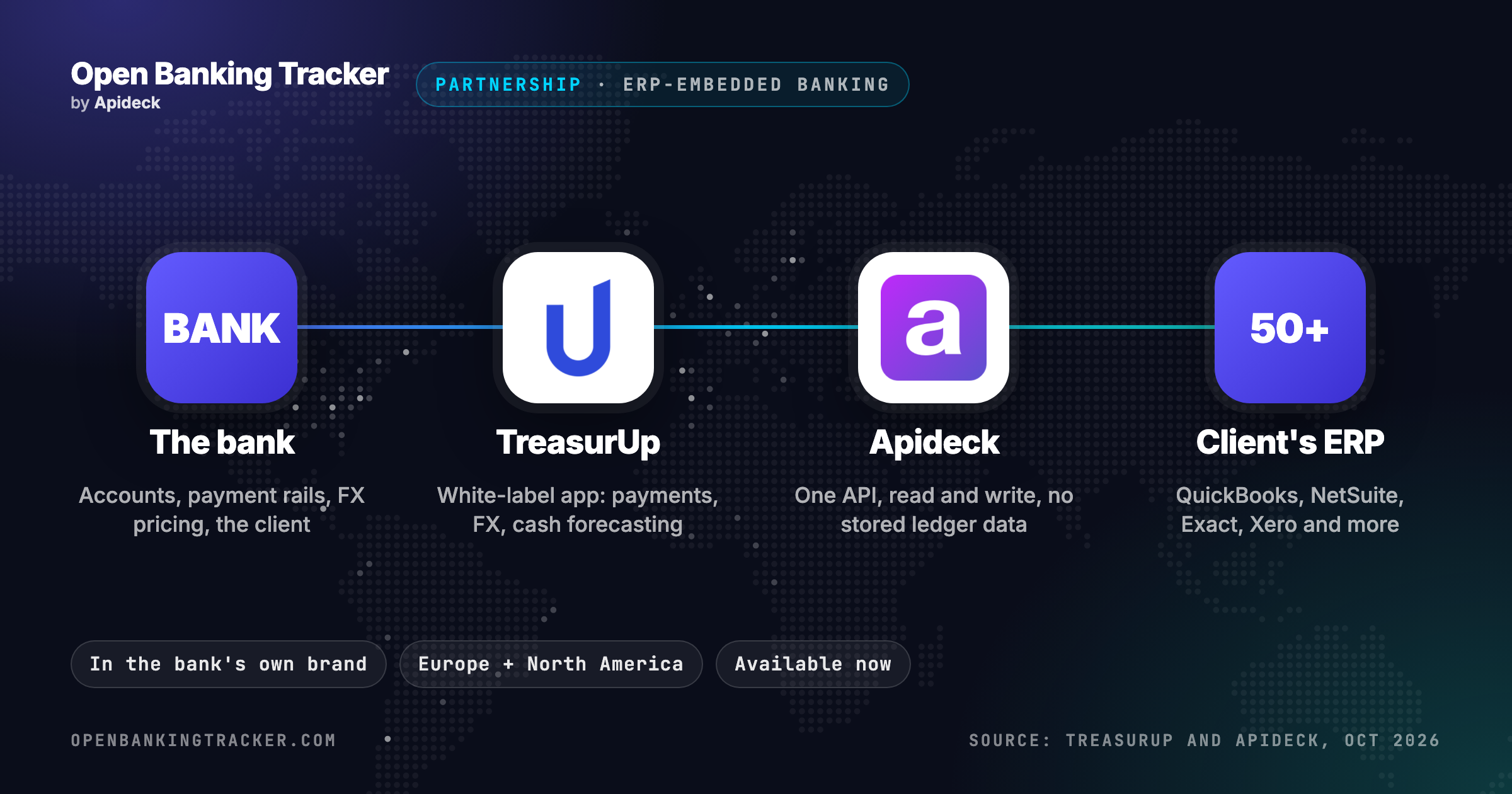
TreasurUp and Apideck have announced a partnership that lets banks put their business banking services inside the accounting and ERP software their clients already use. TreasurUp, the Utrecht-based provider of white-label channel solutions for business banks, supplies the banking workflows. Apideck, the Antwerp-based integration infrastructure company, connects them to 50+ accounting and ERP systems through one API. The joint solution is available to banks in Europe and North America now.
Disclosure: the Open Banking Tracker is published by Apideck.
Key facts
- Who: TreasurUp (Utrecht, Netherlands) and Apideck (Antwerp, Belgium)
- What: a white-label, bank-branded app that brings a bank's payments, reconciliation, FX and cash forecasting into the client's accounting or ERP system
- Systems: 50+ accounting and ERP systems through one API, starting with QuickBooks Online, NetSuite, Sage Intacct, Dynamics 365 Business Central, Exact Online, Twinfield, Yuki, Moneybird, Xero and Sage
- Where: banks in Europe and North America
- When: available now, announced in September and October 2026
The problem: banks hold the account, the ERP holds the workflow
A finance manager at a mid-sized company rarely starts the day in their bank's portal. They start it in QuickBooks, Xero, NetSuite, Sage Intacct, Microsoft Dynamics 365 Business Central or Exact Online. That is where bills get approved, invoices get matched and cash gets planned, and increasingly where the company decides what to pay, what to hedge and how much cash it will have next month.
Most banks are absent from that moment. They still hold the accounts, but less and less of the daily relationship. Business neobanks have moved faster here: Revolut Business syncs bills and payments with QuickBooks, and Mercury puts bill pay next to the business account. For an incumbent bank, building and maintaining a separate integration for every ERP its clients run is a large, open-ended engineering programme, which is why most do not have a complete and consistent ERP connectivity offer.
What the partnership delivers
The model splits the work three ways:
| Party | Role |
|---|---|
| The bank | Accounts, payment rails, FX pricing, liquidity products, and the client relationship |
| TreasurUp | Builds and runs the bank's ERP-embedded app, fully white-labelled: account balances, payment orchestration and reconciliation, with optional FX execution, FX hedging, cash flow forecasting and liquidity management |
| Apideck | ERP connectivity: one API to read and write data across 50+ accounting and ERP systems, embedded authentication and connection management, and a pass-through architecture that keeps no copy of the client's accounting data |
For the bank's business client, the flow looks like this:
- The finance manager connects the company's accounting system to the bank's embedded app once.
- Approved supplier bills appear as payment proposals. After approval, the bank executes the payment and the status is written back to the books.
- Bank transactions land in the accounting system's reconciliation screen.
- Foreign-currency invoices show up as FX exposure, with a hedging proposal that follows the company's own policy.
- The cash flow forecast is built from real receivables, payables and balances, with no spreadsheet upload.
If the company switches ERP, it reconnects. The bank does nothing.
Coverage at launch
| Region | First accounting and ERP systems |
|---|---|
| North America | QuickBooks Online, Sage Intacct, NetSuite, Dynamics 365 Business Central |
| Benelux | Exact Online, Twinfield, Yuki, Moneybird |
| UK | Xero, Sage |
Additional connectors are added on request. TreasurUp brings an existing bank footprint in the Nordics, Benelux and Germany. Its banking clients tracked on the Open Banking Tracker include Nordea, Rabobank, KBC, LBBW and OP Financial Group.
What the two founders said
Niels van Daatselaar, CEO and co-founder of TreasurUp: "Business clients decide what to execute where, at the moment they book an invoice, place an order or see a cash surplus, and that moment includes their ERP. Banks that are not present there risk losing flow or even the daily relationship. With Apideck we can provide a bank with a complete and consistent ERP embedded offer in months, in the bank's own brand, on top of the Transaction Banking and Markets channels that they already run."
Gertjan De Wilde, CEO and co-founder of Apideck: "Every accounting and ERP system has its own API, its own data model and its own partner programme. We take that work off the bank's plate: one integration, 50+ systems with global coverage, and the client's accounting data passes through without being stored. TreasurUp turns that connectivity into workflows a bank can put in front of its clients. Together we let a bank keep the payments, the FX and the conversation."
Where this fits in the ERP banking market
Bank-to-ERP connectivity has turned into its own category among the banktech providers we track. FISPAN embeds treasury and banking services into ERPs through partnerships with NetSuite, Sage Intacct, Dynamics, QuickBooks and Xero. BankiFi focuses on SME banking tools that bring accounting, payments and cash management into the bank's own channels. Treasury and payments vendors such as Bottomline cover bank-to-corporate connectivity at the larger end of the market.
The TreasurUp and Apideck model differs in how it is put together. One partner supplies the bank-facing workflows and channels, the other a unified accounting API. That separation shows up in two ways:
- Build or buy the front end. Banks can launch with TreasurUp's bank-branded channels, or build their own portal, mobile or agent experience on the same accounting API.
- Treasury depth beyond bank feeds. The roadmap starts with payments and reconciliation and runs through FX hedging and liquidity, which is where TreasurUp's background with corporate banks lies.
It also continues a trend we have followed on the tracker: ERP and accounting bank feeds are moving from a one-way transaction import to a two-way channel where the bank writes payments, statuses and FX exposure back into the books. For a wider view of the systems behind it, see our open accounting directory and the list of banks with QuickBooks bank feeds.
Frequently asked questions
What is ERP-embedded banking?
ERP-embedded banking puts a bank's services, such as payments, reconciliation, FX and cash forecasting, inside or right next to the accounting or ERP system a business already uses. The client approves payments and sees bank data where it keeps its books, in an app branded by its own bank.
What do TreasurUp and Apideck each provide?
TreasurUp builds and runs the bank's white-label app and its banking workflows: payment orchestration, reconciliation, FX execution and hedging, cash flow forecasting and liquidity management. Apideck provides the connection to the client's accounting or ERP system through one API to 50+ systems. The bank keeps the accounts, payment rails, pricing and the client relationship.
Which accounting and ERP systems are supported at launch?
In North America: QuickBooks Online, Sage Intacct, NetSuite and Dynamics 365 Business Central. In the Benelux: Exact Online, Twinfield, Yuki and Moneybird. In the UK: Xero and Sage. Apideck's API covers 50+ accounting and ERP systems in total, and more connectors are added on request.
Does Apideck store the client's accounting data?
No. Apideck uses a pass-through architecture: the client's accounting data flows between the ERP and the bank's app without Apideck keeping a copy of the books.
How is this different from a bank feed?
A bank feed sends transactions one way, from the bank into the accounting system. ERP-embedded banking works in both directions: bills in the ERP become payment proposals at the bank, payment statuses and FX exposure are written back to the books, and the cash forecast is built from receivables and payables in the ERP.
Which banks can use it?
Banks in Europe and North America. TreasurUp already works with banks such as Nordea, Rabobank, KBC, LBBW and OP Financial Group. A bank starts with an intake, after which both companies propose a rollout plan and commercial terms.
How banks can start
A bank starts with an intake. The joint team then proposes a rollout plan and commercial terms based on the modules chosen and the expected number of connected clients. Projects usually start with one client segment and one workflow, such as reconciliation or ERP-driven payments, then expand.
Read the full announcement on the Apideck blog, or see the joint solution and request a meeting on the Apideck × TreasurUp partner page.